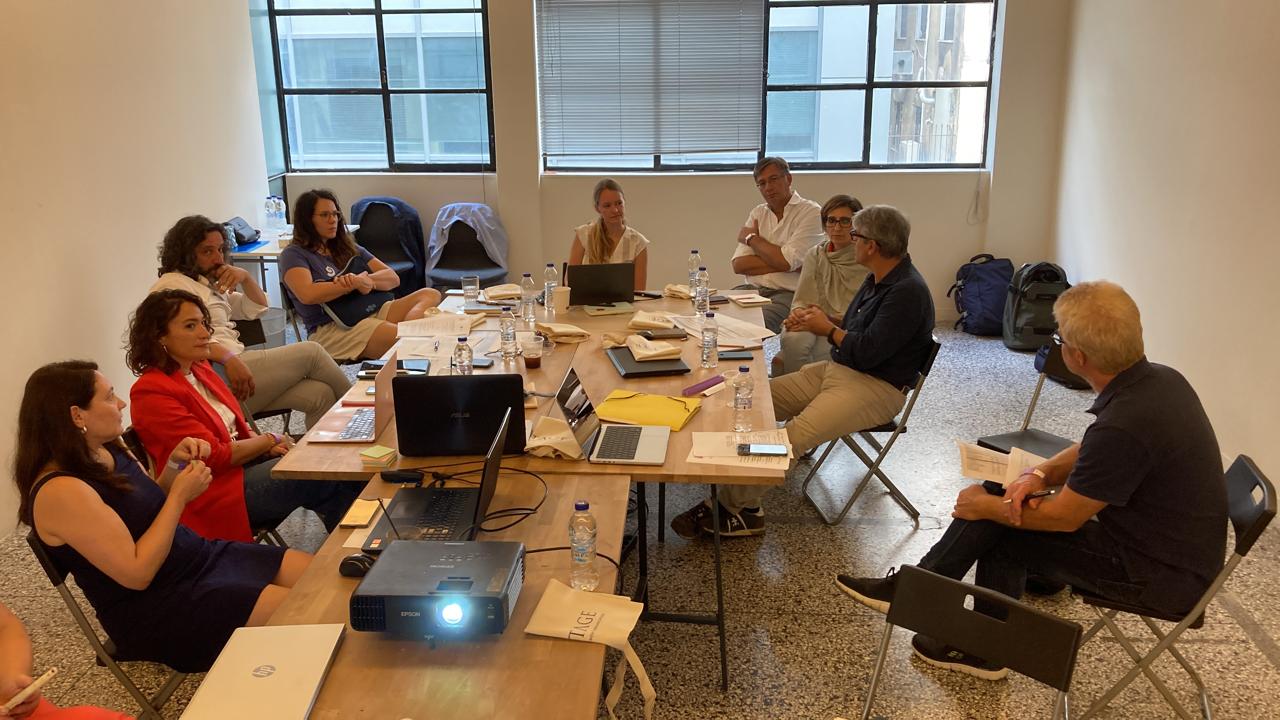
Athens, Greece – 18–19 September 2025.
The EMPATHS consortium convened at the creative hub “Romantso” in Athens for the project’s second Transnational Project Meeting (TPM2). Over two productive days, partners assessed progress across all Work Packages and shaped the next phase of work: developing and testing the EMPATHS participatory heritage interpretation training programme.
A Project Reaching Its Midpoint With Strong Momentum
The meeting opened with an overview of the project’s status as it approaches its halfway point. With the research phase now complete, partners are moving into the core phase of designing and preparing the training programme. The first progress report, submitted in July 2025 and accepted with minimal comments, confirmed solid achievements to date and highlighted the strong collaboration across the consortium.
Finalisation of the Methodological Compendium
One of the central topics of discussion was the near-finalisation of the methodological compendium for participatory heritage interpretation. The compendium brings together:
- An overview of the current landscape of participatory heritage interpretation
- Ethical principles based on social inclusion and democratic participation
- Practical steps for co-creating meaning with communities
- A methodology covering stages from situational analysis to collaborative evaluation
Partners are now finalising formatting, refining the glossary, and selecting an engaging public-facing title. Popular proposals included “Interpreting Together – A Co-Creative Framework for Inclusive Heritage Engagement” and “From Audience to Co-Creators.”
Developing the EMPATHS Training Programme
Work Package 3 discussions focused on consolidating the Skills Manifesto and preparing the structure of the training modules.
Online Training Module
The proposed online module includes six sessions (up to 180 minutes each), introducing heritage professionals to key principles and skills such as:
- Foundations of heritage interpretation
- Community and power mapping
- Co-creating narratives
- Participatory planning and facilitation
- Sustaining engagement
- Assessment, feedback and reflection
On-Site Community Labs
Following the online module, participants will take part in a 40-hour on-site community lab together with local community members. These labs will focus on applying participatory methods in real heritage settings, encouraging collaboration, empowerment, and mutual learning.
Piloting and Evaluation Plans for 2026
In preparation for Work Package 4, partners outlined the full piloting timeline for 2026, which includes:
- Recruitment of participants for the online and on-site modules
- Delivery of online modules from May to August 2026
- Piloting of three community labs in September 2026
- Evaluation and analysis of participant feedback
- Revision and validation of the training programme by early 2027
The next Transnational Project Meeting (TPM3) will take place in April 2026 in Pozzuoli, Italy, across multiple sites within the Campi Flegrei Archaeological Park.
Strengthening Communication and Outreach
The consortium also reviewed ongoing dissemination efforts. The EMPATHS website now features multilingual pages and 18 blog posts, while social media communities continue to grow on LinkedIn, Facebook and Instagram. Partners committed to supplying more images, updates, and local stories to support new campaigns and ensure regular publication of blog posts and newsletters.
Looking Ahead
The Athens meeting marked a pivotal moment, with the project transitioning from intensive research to the development and piloting of training activities. With the methodological framework nearly finalised and preparations for 2026 underway, EMPATHS moves forward with a strong shared commitment to fostering inclusive, participatory heritage interpretation across Europe.
The EMPATHS project is co-funded by the European Union under the Erasmus+ programme.